Tuesday, June 21, 2011

Florentine Sunsets

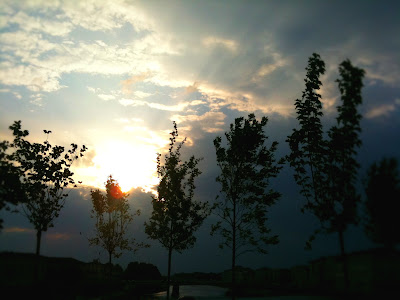
In addition to some phenomenally sexy and sublime Monteverdi singing from my colleagues, Florence has also offered countless stunning sunsets. Crossing the Arno every night, walking to or from work, I have been greeted by some of the most beautiful sunset views I've ever seen. I tried to capture as many of them as I could with my iphone or camera. Here are some from these last few weeks here.


Friday, June 10, 2011

The Cognitive Power of Breath

During my first semester of Opera Workshop at the University of Michigan, our director and teacher’s mantra was “remember your breathing”. At the time, I remember thinking that such advice was so obvious that it bordered on the obtuse. “Of course I’m breathing! How could I sing otherwise?!” I thought. It didn’t take long to dawn on me that he wasn’t asking me to remember what my voice teacher was trying to teach me – he was trying to get me to slow down my perception of time and root myself in the present moment.

As my yoga practice has intensified over the past few years, I’ve been thinking a lot of that seemingly simple advice from my Opera Workshop class at University. Just about every yoga teacher tells their students to focus on their breathing – it’s integral to the whole moving-meditation aspect of yoga. As I flow through my practice, I do my best to make sure that my feet are grounded, my knees in line with my middle toes, and my sacrum properly aligned all while I try to twist my body and my arms in all sorts of directions – it's a lot that one has to be mindful of as one flows from one pose to the next. I’ve found that in the midst of trying to achieve these crazy contortions, it’s been that focus on the breath that allows my panic and frustration fade way to clear-headed mindfulness, allowing me to ease my way into deeper realizations of the poses.

The ceiling of the Théatre des Champs-Élysées

While I was touring Handel’s Ariodante with Il Complesso Barocco last month, I found myself in a rather extraordinary situation in which I was making three major debuts in three very famous venues in three different countries within the space of a week. People often ask me if I ever get nervous – I would be lying if I said that I wasn’t that week. While I was excited about all of those concerts, I think that the one I was most excited about was our performance at the Théatre des Champs-Élysées, which marked my Paris debut. After dreaming for so many years of getting the chance to sing in Paris, I found myself making my debut there with some of the most fantastic colleagues I have ever had the pleasure of working with on the very stage where Stravinsky’s Rite of Spring premiered 98 years earlier. Getting ready for the concert, I kept marveling at how incredible it was that I was getting to make a debut in Paris in such style.

Sitting on stage as patiently as I could until the end of Act I, waiting to sing my first aria, I felt my excitement turn slowly into nerves, the voices in my head starting to shout out thoughts of unworthiness and painting out scenarios in vivid detail in which everything went awry. As my mind would start to wander off into some alternate universe of doubt, I found myself constantly coming back to my breathing, letting the sensation of the inhalations and exhalations carry me back to the present moment, which was in reality, one to savor and enjoy. When I finally got up to sing my first notes of the night, it was that focus on the breath that allowed me to completely clear my mind of its crazy inner dialogue and open myself up to letting Lurcanio’s story flow through me. My breathing didn’t just help me sing well, leading my expressions and emotions, but it also helped channel my thoughts to the present moment and focus on the task at hand. Funnily enough, the advice that I initially thought was so silly in college proved to be the one thing that enabled me to enjoy our performance that night.

I’ve been watching a lot of the archived TED talks lately in my free time here in Florence, and I stumbled across this one given by the soprano, Claron McFadden, last year, in which she sings a cool piece by John Cage – Aria. Her story about her experience at a meditation retreat in Thailand is what really struck me about her talk – I loved how her host compared singing to a meditation. My experiences over the past few weeks have made me think of singing the same way lately.


Friday, June 03, 2011

Thoughts on Practicing

We could all stand to channel this little guy in our own lives, I think...


Happy weekend everyone!

Wednesday, June 01, 2011

Catching Up

Sorry for the light number of postings so far this year...I've been a bit overwhelmed with all of the singing that's been going on lately. I'll try to pick up the pace in the coming weeks...

In the meantime, for your viewing pleasure, here's a picture of one of the many sunsets I've been enjoying here the past few days in Florence, Italy.

It's a rough life, I tell you... :-)

And for your reading pleasure, here is a repost of my most recent entry at the Collaborative Institute of Chicago's blog, Collaborative Musings:


WHAT DO YOU WANT TO DO?

Let’s start this entry off with a few statistics. In these first 5 months of the year, I have given 28 performances of repertoire ranging from Bach to Britten. In those 28 performances, I performed 2 operas (Rossini’s Il barbiere di Siviglia and Handel’s Ariodante), 6 oratorios (Carmina Burana, Beethoven’s Symphony No. 9, Bach’s St. John and St. Matthew Passions, Bach’s B minor Mass, Mendelssohn’s Elijah), a ballet (Stravinsky’s Pulcinella), an orchestral song cycle (Britten’s Serenade for Tenor, Horn, and Strings), and a song cycle for harp and tenor (Britten’s Birthday Hansel). It’s been a very exciting first half of the year so far, filled with incredible music and music-making colleagues.

The main reason I list all of these statistics is simply to give you a snapshot of how intense my musical life has been like since New Year’s. With so much wide-ranging, diverse repertoire to keep abreast of, it’s been quite challenging to keep abreast of it all without tying my throat in knots. The most intense period was when I found myself singing 8 concerts in 3 different cities in the first 9 days of April. At the beginning of week, I found myself wailing at the extreme heights of my range for Carmina Buranas in Denver, only then to fly back East to jump back and forth between Stravinsky’s arrangements of Pergolesi’s delicate vocal music for concerts in Philadelphia and the intricate twists and turns of Britten’s last song cycle for recitals in New York. In those 8 days alone, my vocal cords musically spanned 250 years.

In my efforts to stay on top of all of this diverse music and the packed schedule of the past few months, I’ve spent as much time as possible checking in with my voice teacher in New York during my days off between concerts. In our lessons over the past five months, I’ve noticed her asking me a musical question with increased frequency that has rarely been posed to me: “What do you want to do?”

Every time she has asked me that question in a lesson lately, it has inevitably been because I had no idea what I wanted to do in that particular place. It was a spot that I had glossed over or taken for granted. It was a phrase for with I had no specific plan. The best part is that each time she has asked that question, it has forced me to find an answer. It’s forced me to make choices. Both the grueling schedule and my teacher’s insistence on decision-making have forced me to take even more ownership of my musicianship.

In so much of our training as singers, we are taught how to sing by our teachers, taught musical styles and phrasings by our coaches, taught how to enunciate text by our diction coaches. Then after all of that preparation, we begin to rehearse with conductors who show us with their batons how they want the music to be sung and directors who shape our performances through their stage direction. But in the midst of all of that, it’s important not to become too passive. It’s important to keep thinking about how all of this information allows us to enhance what we are already trying to do. Both the grueling schedule and my teacher’s insistence on decision-making have forced me to take even more ownership of my musicianship.

Going back to my blog post a few weeks ago about – I have been finding that so many young singers are incredibly focused on trying to plan out their careers. Lately, I’ve found myself musing again on what I wrote back then – career plans are important, but it is our musical plans that are of the highest priority. When it comes to the music – do you know what you want to do?

Sunday, May 15, 2011

Northern Serenades

Rehearsing in the Johannes Church, Helsinki, Finland

This past weekend, I took a trip to the most northern place I've ever visited so far - Helsinki, Finland. I had the most fantastic time exploring the city and spending time the English Chamber Orchestra, who were my phenomenal musical partners-in-crime for our performances of Britten's Serenade for Tenor, Horn, and Strings. The most stunning thing about being so far North was how long the daylight would last - I've never experienced so many hours of light in one day before. Our second concert was also the final concert of the Helsinki Spring Light Chamber Music Festival, which is aptly named. Even though our concerts didn't end until just after 9pm each night, the sun was still quite high in the sky, not setting until well after 10pm. It was nice to leave concerts during the daylight for a change.


Our final concert was broadcast live online - in case you'd like to see it, you can still watch it online here until May 24. The Britten Serenade starts roughly around minute 57:00.

I hope you enjoy!

Saturday, May 07, 2011

Questions on the Train

Hi there...

Sorry for my absence this past month. I got a bit overwhelmed with all the music and travel and good times. It was fun, but I fell of the blogging wagon, so to speak...

I'll have more soon, but in the meantime, here's a video I stumbled across last month. Interesting questions, interesting responses - stick with it until the end, if you have the 12 minutes or so...it's worth it.

Friday, April 01, 2011

How My Past Almost Caught Up With Me

About nine years ago, I was driving up to Glimmerglass for my second summer as part of the Young American Artist Program when I got a strange call on my relatively new cell phone. It was my voice teacher from the University of Michigan calling to ask if it was ok to give my number to a music producer in LA who was looking for an operatic tenor to record a track for a project he was working on. She said that the man was also a graduate of UM and had asked the Dean to recommend someone for this project. The Dean had kindly suggested me, and my voice teacher wondered if it would be ok for them to pass my contact information on to him so that he could contact me about the project. I was young, constantly strapped for cash, and open to any way I could make a paycheck singing, so I said, “Sure – give him my number and have him call me.”


The project turned out to be recording “So This is Love” from the Disney cartoon, Cinderella, for the upcoming new ice show, Disney On Ice: Princess Classics. The producer explained to me that this was for the climactic moment in the second half of the show, and they were looking for an operatic tenor to do the vocal track to give the track as much grandeur as possible. Because I was busy at Glimmerglass, I ended up recording the track at a little studio in Albany, NY with a synthesized Midi-mock-up of the arrangement that they were planning on using. The producer was patched in from LA and coached me as I sang take after take along with the synthesized mock-up until he said he had what he wanted. He told me that he was going to mix my vocal track in with a big orchestra and choir that he was going to record in LA at a later point and that it was going to sound great once it was finished. He thanked me for my work, and I cheerily wished this man I never actually met goodbye and thanked him for the opportunity. I drove the 90 minutes back to Glimmerglass and promptly put the whole episode in the back of my mind as I was swept away by the stress of the summer.


A few months later, I had just moved to Houston, and I noticed that Disney Princess Ice show was coming to town. I begged my fellow studio artists to go with me so that we could hear the final version of what I recorded, thinking how hilarious it would be to have a bunch of opera singers go to a figure skating show about Disney Princesses. But to no avail – I couldn’t convince anyone to go with me. Between that and my busy rehearsal schedule at the opera, I never made it to see the show. I never heard the final version of my Disney-Voice moment.


Skip to almost a decade later, and as I was walking back to my hotel after a long rehearsal here in Denver Wednesday night, I noticed that the digital marquis outside the Denver Center for the Performing Arts was advertising, “Disney On Ice: Princess Classics! In Denver March 30 – April 3 2011!” My curiosity was piqued – could it be possible that I would be performing in two different venues at the same time this weekend? With a figure skating show at the Denver Coliseum and with the Colorado Symphony? Was it possible that I was – in a strange way – going to be in two places at once?


So I made a few phone calls to see if I indeed was going to achieve the impossible and sing in two places at the same time. I called the entertainment company that produces the show and was passed along to a very nice woman who offered to help me get to the bottom of it all and figure out if they were still using that track I recorded back in the summer of 2002. She said she would do a little digging and give me a call back. And she very kindly did just that – and she regretfully informed me that they were not using my recording anymore. “The music department did remember recording it and using it, but the vocal track was apparently replaced a while ago during one of the revisions of the show. I’m so sorry, but it’s not you singing anymore,” she said apologetically. I thanked her for her help and time, and sadly hung up the phone. I was surprised at how disappointed I was that my track had been replaces. It was a fun anecdote that I was rather fond of telling people when reminiscing about my beginnings as a professional musician. Aside from selling porn at the Classical Music cash register in Tower Records (our department sold more porn than classical CDs, strangely enough), it was one of the more unusual ways I earned my wages back in those early days of young adulthood. I was sad to discover after all this time that the record of it had disappeared, without ever having had the chance to hear it in its final version.


At least I still have the memory of the experience. My short-lived moment as a Disney-voice was fun while it lasted. Now my Disney-singing will be confined to karaoke bars – although I’ve moved on to other Princesses these days. I’m all about Ariel and Princess Jasmine now. Cinderella is SO yesterday.


Thursday, March 24, 2011

Om

My favorite yoga studio is coincidentally located just two and a half blocks down the street from the stage door of Davies Hall, the beautiful home of the San Francisco Symphony. During my last few trips to San Francisco, I’ve made it a habit to take as many classes as I can fit in while I’m there. While I had been looking forward to this last set of concerts with the San Francisco Symphony for quite some time simply for the chance to sing one of Bach’s greatest pieces with such a great orchestra, I was also looking forward to having another opportunity to take a week of classes at Yoga Tree.

After a mildly annoying trip west on Sunday night, I awoke slightly jet-lagged and eager to start both my first rehearsal and my first yoga class on Monday morning. I went out in search of some coffee, stumbled through writing some rather unfocused and incoherent morning pages, and then made my way down to my first class of the week. I settled onto my mat in my little corner of the studio, and the teacher began to lead us in the initial chanting that would begin our class that day. Before we repeated the day’s chant for the third and final time, the teacher asked us to stop for a second and consider the following as we brought our chanting to a close. As we chanted our last round, she asked us to be sure to hear every single, individual voice in the room, as well as our own, as a way of feeling the whole that we were part of, while still being conscious of ourselves. I opened my eyes and looked at her, surprised, for a quick second before we started again, marveling at the themes for the week that were so blatantly making their presence known before I began the Bach-ian journey of the coming days.

For the rest of the class, I found myself meditating on what it is to sing Bach, and the particular challenges it poses for the singer. I often contend that Bach’s vocal music requires complete selflessness in order to be performed successfully, yet as I contemplated my toes in a downward dog pose, it occurred to me that this isn’t a complete truth. Bach also requires the singer to be keenly aware and mindful of every single phrasing nuance, technical turn, and note that they are singing, demanding a strong sense and awareness of musical self while all the time being attentive to the interplay of all the voices (whether human ones or instrumental obbligatos) around their own vocal line. Being the bearers of the text, we must deliver the message and project our own voice, yet we must always remain part of that whole, conscious of the interweaving countermelodies around our line. If we fall off balance in either direction, we risk obliterating the delicate, beautiful, complex contrapuntal tapestry that we are but one part of.

Be aware of every single voice around you while being aware of your own. It is such a basic fundamental of chamber music – yet hearing it out of context, it shed a different light on the idea, making it seem completely new. Suddenly I was understanding that fundamental on a much deeper level. Be conscious of the whole you are a part of, while being conscious of your part in that whole. It was incredibly strange to hear that in such a different, seemingly unrelated context, but just how unrelated is any one thing from any other, really?

Monday, March 14, 2011

New Collaborations

My colleagues Shannon McGinnis, Nicholas Hutchinson and I have started a new vocal arts institute in downtown Chicago that we are very excited about: Collaborative Arts Institute of Chicago. I've known Nick and Shannon since we were all students at the University of Michigan together, and we are excited to be kicking off this new adventure that will be both an educational resource for young singers and pianists in the Chicago area and (as soon as we raise a bit of money) a place for musicians and audiences alike to explore vocal chamber music in performance. You can read more about what we are doing (and even donate...) at our spiffy, new website: www.caichicago.org.

At our brand spanking new website, there is a blog called Collaborative Musings, where I will occasionally post a few ramblings from time to time in addition to the musings of my colleagues and our guests, and I plan on reposting those pieces here, as well. My first post at Collaborative Musings is below:


BACK TO BASICS

In the February issue of Details magazine, there is an article that talks about the rise in entrepreneurial culture in the US recently. They write: “The act of striking out on your own is hardly a new phenomenon – it’s in the DNA of the American Dream, after all – but it might well be today’s savviest career move.”

Back in 2005, writing about the current system through which most singers rise, Anne Midgette wrote in a New York Times article:

"A baseball-like farm system has developed in American opera in recent decades, as more and more young-artist programs have sprouted up around the country. Aspiring singers now follow a career path from a music degree and graduate school to a residency with a smaller house to, ideally, a place in one of the top programs for young artists: the Metropolitan Opera's Lindeman program, the Chicago Lyric Opera's center for American artists, San Francisco's Merola program or the Houston Grand Opera Studio. From there they are theoretically ready for the big leagues.” (NY Times, 11/13/2005)

When I enrolled in the voice program at the University of Michigan as an 18 year-old freshman, I quickly ascertained that this was a smart path to follow, and set my sights on following it as closely as possible. When home for holiday dinners, talking about my aspirations with my parents' friends, I would say, “Well, my plan is to get a master’s degree, and then hopefully join one of the major young artist programs, and from there hopefully find an agent and start building my career from there.” I was convinced it was a sure road to a big career, and I naively thought that if I could make it into one of these “top programs for Young Artists”, I was sure to find instant success. I knew with great certainty that I would be "ready for the big leagues".

I was one of the lucky few to be able to follow the institutional path that I set out in front of myself, quite closely – but was surprised to learn that even though I was lucky enough to have been afforded the opportunities I was, none of it meant that I was going to make my dreams come true by just proverbially adding some water and stirring. There was a long path of hard work still ahead of me, and there were still basic skills that I had to hone and keep working on that had been glossed over in my haste to get to where I thought I needed to be.

There is a lot of talk amongst young artist programs and training programs in schools today about the “Business of Singing”. American singers of the generation that graduated with me in 2001 (as well as further back) lament never having learned while in school the important lesson that when you choose to be a professional musician, you are running your own business. It is my impression that educational systems and young artist programs are now trying to remedy that, and teaching young singers that they need to start thinking of themselves as "Young Singer X, Inc." Now, there is an abundance of resources helping students and young artists alike choose the right 5 audition arias, choose the right audition outfits and headshots, and format their resumes so that they can fit themselves into the right boxes (fachs) to be most marketable to opera companies and opera administrators around the country.

In an economic age where opera companies, symphonies, and other presenting organizations are folding or downsizing left, right and center – it’s all the more important to be thinking creatively and embracing that spirit of entrepreneurship that was featured in that recent issue of Details. But I pose this: As young musicians, when we are thinking creatively about creating work for ourselves and how to market ourselves, thinking about our music and our music-making should be of the highest priority. In order for us to open the creative flood gates, we have to come back down to basics and meditate on what is at the core of what we do – music itself. How can we best hone our skills? What music is it that makes our hearts beat faster? How can we be the best that we can be in order to serve our communities in the most meaningful way possible?

The arts are definitely in a period of upheaval and cultural shift right now. There is a lack of money, and many institutions are struggling (for instance, the Detroit Symphony recently canceled the rest of it's 2010/2011 season recently as a result of its unsuccessful labor negotiations due to the orchestra's financial struggles), and signs seem to indicate that it is not going to get significantly better any time soon. Many bloggers and administrators are tossing around various ideas about how to market classical music and opera to wider and wider audiences. Many institutions are attempting to draw in audiences by crossing over. The Metropolitan Opera, for instance, presented Andrea Bocelli in a solo recital this year. But when I think back to what drew me into classical music, and what has drawn core classical-music lovers to the artform, it was not watered-down, crossover classical experiences – it was the core repertoire. Most classical-music lovers I know fell in love with the classical repertoire listening to Mahler symphonies, or hearing a phenomenally personal and beautifully-sung performance of something as simple as “Caro mio ben”, or seeing an exciting performance of the Dvořák Cello Concerto. This fear that the classical arts are “in trouble” is causing people to panic, and in the desperate search for people to fill the seats in our concert halls and opera houses, our focus is becoming diffuse, and therefore losing its impact. Rather than trying to energize and empower our core audience, we are leaving them by the wayside and scrambling for this nebulous idea of “wider audiences” and wondering why we are feeling like the classical arts are losing their cultural impact. Which culture are we trying to impact? Who are we trying to talk to?

At a Q & A session I conducted recently at a University with a very well-respected vocal program, students’ questions primarily centered on these things. Their questions were along the lines of “how do I get myself into the best young artist program possible?”, “what should I wear to my auditions?”, “do I need a website?”, “which competitions should I apply for?”, “which programs should I sing for?”. Curiously enough, though, not one question I was asked was related to music or the art of singing. Instead – the questions were all basically asking about different aspects of the same thing: “how can I best market myself as a commodity that can be bought and sold by an opera company?”

Like this larger debate that looms around the classical music community, the students at that Q & A session a few months ago seem like a smaller part of what is going on in our artistic macrocosm. In a way, while the questions they posed are important ones to be asking, they are of secondary importance. It’s important not to put the cart before the horse. What does this mean for us as young musicians and performers? It means that we must prioritize digging even deeper, pushing our technical boundaries even farther, and searching inside ourselves for more openness of hearts in order to give the most layered and expressive performances we can to our audiences.

Here’s another way to think about it: It’s a basic fundamental of any business: if you want people to buy a product, the first thing you have to be absolutely sure of is that your product is of the highest quality.
Sunday, March 06, 2011

Detroit Memories


People not familiar with Ann Arbor often mistakenly assume that it is one of the many suburbs of the Detroit area. Surrounded by a green belt, with the sprawling University of Michigan campus dominating much of the somewhat insular, academically high-minded community, and situated a solid 45 minutes away from the Motor City on a Sunday morning with no traffic, Ann Arbor is very much a community unto it’s own compared to the suburbs that ring Detroit like Bloomfield Hills, Farmington Hills, Livonia, Novi, Auburn Hills, and Grosse Pointe. As a result, when I was growing up there, Detroit felt very removed from the home I spent my childhood in, and being lucky to have an incredibly strong music presenter in town that brought in elite classical music groups from around the world, I probably only attended only a handful of concerts at the Detroit Symphony before I left home at the age of 22 to venture out into the big, wide world and begin my life as a professional musician.


That said – it was impossible growing up as a young, ambitious musician in Southeastern Michigan to be unaware that one of America’s major symphony orchestras was less than an hour’s drive away. For all four years of high school, one of my dedicated parents would drive me to Birmingham every Saturday and wait for me while I rehearsed all morning with one of the youth orchestras I played with as a young string player, the Metropolitan Youth Symphony. While I was in the violin and viola sections of MYS, a large percentage of the players in the organizaton studied with many of the players of the DSO, accounting for the exceptionally high level of playing in the youth orchestra. We played one concert each year at Orchestra Hall (the DSO’s home at the Fisher Center), and we worked our hardest for that concert every year, knowing what an honor it was to play on the same stage that many of our teachers played on throughout the year as part of one of the nation’s great orchestras.


Many of these same players would also commute to Ann Arbor on Sunday afternoons to play with the University of Michigan Youth Symphony, which also had an incredibly high standard of playing, and was even more difficult to get into. That high standard actually accounted for my switch to being a singer – after a year of playing with the University of Michigan Youth Symphony viola section, I didn’t make it back in when I re-auditioned for a second year because my playing wasn’t up to the level that year. Rather than succumb to disappointment, I decided to audition for the University’s Michigan Youth Chamber Singers, and my journey as a singer began in earnest. Years later, as a young singer in college, I would sing twice with the Detroit Symphony as a chorus member for some Holiday Concerts and performances of Messiah – they were my first experiences working in a professional symphonic situation and seeing both how incredibly inspiring it could be and how tense and temperamental it could get making music at such a high level.


I was not the only one of those young people who chose to pursue a career and life in music as a result of those formative years as young musicians in the Detroit Metro area – most of my friends from those heady Youth Orchestra days are professional musicians today, many of whom now have their own private studios of young students, passing on that high level of musicianship that we were so lucky to grow up with on to the next generation of young players and singers. Others who don’t play so much any more have taken jobs elsewhere in our industry at record companies like EMI, as well as administrative positions at arts organizations. The few of us who stopped playing and embarked on other paths altogether quite consciously maintain music as an important part of their lives and still play in their spare time.


Watching the Detroit Symphony go through its recent struggles this season has been heartbreaking when I think of its impact on my formative years. The irony is that it seems that much of the reason the negotiations between management and the players have been so unsuccessful has been related to community service issues. It’s caused a crisis of public image for the Orchestra – many of the comments on the Detroit Free Press’ February 21st editorial about the situation are quite vicious. The first two posted were: “So, musicians ultimately want to avoid outreach to the Detroit community. But, they want the support of the Detroit community?...” and “How many people are really going to miss the DSO? Both sides deserve to reap the rewards of their inability to reach a compromise…Good Bye and good riddance.”


Towards the end of a Delta flight that I flew back from vacation last month, out of sheer boredom, I picked up the complimentary copy of the airline’s magazine and noticed that the entire February issue was devoted to articles showing how Detroit was a city on the rebound. The Renaissance there really is continuing to happen, the mayor assured us, and it really is a wonderful place for businesses and people to base themselves. I was impressed to see that the city is taking a newfound care with its image and is putting effort into trying to rebuild itself. Yet flipping through the magazine, the plight of the DSO was forefront in my mind, discordant with the images in the Delta Magazine.


This weekend I am in Omaha, celebrating the Omaha Symphony’s 90th anniversary with some performances of Beethoven’s 9th Symphony. It’s a big milestone for them, and the community here is celebrating with appropriate enthusiasm – this past week there was a very nice article in the Omaha World-Herald about the orchestra’s anniversary. Something jumped out at me in their profile however:

“The Omaha Symphony has felt some pain – some cutbacks, but no layoffs – from the recession that hammered arts organizations’ endowments and the investment holdings of many prospective donors.

What’s different in Omaha, the symphony leaders said, is that the economy didn’t fall as far, the symphony has a fantastic new home in the Holland center and local philanthropists and business leaders consistently prioritize supporting the arts.

‘We have a number of very wealthy people in Omaha who are very generous in supporting the symphony, as well as people who buy our tickets,’ said Pamela Cleary, interim president and CEO of the symphony. ‘They understand our mission and feel it’s vital to our community.’ Business people, in particular, see supporting the symphony as a way to keep and recruit talented employees, as well as create a vibrant arts environment for the community and opportunities for young people, she said.” - 3/3/2011, Omaha World-Herald

What people like the commenters on the Free Press editorial don’t seem to understand is that organizations like the DSO don’t operate in a vacuum, and their extinction has a ripple effect throughout the community – much as the DSO did when it was a successful, functioning symphony orchestra when I was a young, impressionable ‘tween. The symphony’s impact on me as a distant resident in the Metro area was certainly indirect, but it was no less impactful than those influences I experienced directly as a student. The orchestra’s presence created an atmosphere that supported at least three top-notch youth orchestras in the area, not only keeping hundreds of kids out of trouble but also helping them develop skills that would impact the rest of their lives, all the while adding to families’ sense that the Detroit Metro area was a stable, good place to live and raise your children. Communities are ecosystems, and as in any ecosystem, when one part of the food chain dies out, the rest of the system feels an effect.


Whatever the case, I do hope that the Symphony is not only able to survive this crisis, but also resolve their troubles very soon. It would be tragic to me if the orchestra's community influence and their players' tradition of excellent standards in music education weren’t able to continue. Without them there, I’m not sure I’d be coming back to a community that I recognize as home, and it would be devastating to see a part of my own musical history die away.

Friday, March 04, 2011

Shutting Down

I received an email from a good friend today saying, “…let's finalize things soon, because I'm actually going on a silent retreat (no phones, internet, or TALKING - can you imagine anything more frightening?).” I laughed aloud reading it, thinking that actually, in this day and age of smartphones, Twitter, Skype, and Facebook that it could conceivably sound a bit like a horror movie to some – something like “The Social Network’s Nightmare On Elm Street: Mark v. Freddy”.

As the run of Barbiere came to a close in Seattle at the end of January, I was keenly aware that while February was going to be a month of downtime this season, my schedule from March – July is blessedly brutal, pressure-packed, and busy. Not having been on a proper vacation since August 2009, I decided that I would take the first week of last month and visit some sort of paradise for some much-needed and necessary R & R. I’ve wanted to visit Hawaii my entire life, and since I was already on the West Coast, I figured, why not go? What better way to shut down than go to Hawaii and park myself on the beach for a week?

The one perk of Hawaii is that it is a State – so, as an American citizen, you can go to one of the most remote places on Earth, and you don’t even need a passport. But when it comes to shutting down – the fact that it’s a state means that things like American cell phones work there. So in order to get the complete retreat experience, one has to do what my friend is going to do in April, and quite voluntarily, consciously turn off one’s devices.

Ten years ago, such a task would not have been too challenging. The heavy, black bulky rectangle that I called my laptop computer was so painfully slow to start up that I rarely had the patience to turn it on. Hi-speed internet was a luxury rather than something to be taken for granted, and I was only just about to purchase my first mobile phone. Now, my iPhone is like a new body part that I have had surgically attached to me, and, as a result, I have constant access to the internet, email, text messaging, and any other mode of communication that is currently possible. When I’m not running from place to place and able to plug in, I tend to have my eyes glued to a screen of some sort, reading news, email, or some blog someone wrote somewhere.

Realizing that I very much needed to fall off the grid for a week in order to really make the most of this vacation, I resolved to turn off the phone and leave it in the room and to refrain from purchasing internet access through the hotel while I was in Hawaii. Aside from needing to get on the internet once in order to buy a plane ticket that I had forgotten to take care of before I left, I managed to do pretty well. But I was saddened to realize how much it was a real challenge to truly shut down – I still felt a burning need (which I gave into) to check my email on my phone once a day. It sadly felt like a big treat that I was allowing myself, because otherwise my vacation started to feel like a white-knuckled, unpleasant fast as opposed to a pleasant time to relax. I felt like an addict going through withdrawal – desperate for just one hit of whatever drug I was hooked on.

As the sweaty, shaky pains of my withdrawal wore off, I realized just how much I don’t take in the world and people around me as much as I used to. Soon, I was grateful for leaving my phone in my room, because it allowed me to soak in the warm Hawaiian sun and watch all the fascinating people around me. I saw whales breach in the Pacific, I marveled at surfers doing amazing tricks on the incoming waves, and I had amazing bonding time with my boyfriend as we both simply sat and took in the beauty of the landscape that surrounded us. I felt the knot of anxiety that is generally wound so tight within my core gradually uncoil and loosen as my week in paradise progressed. It was heaven. And I started to wonder, why don’t I shut down like this more often? I mean, how hard could it be to turn off my cell phone at the end of the day and not open up my computer past certain hours?

Incredibly difficult, it turns out. I’m a little shocked at how quickly all of this technology has infiltrated my life. I am generally connected 24 hours a day, 7 days a week when I am going about my non-vacational, very vocational life. It’s no wonder that coil of anxiety is able to wind itself so tightly inside me so much of the time. It’s also no wonder that it can be so hard to be firmly rooted in the present moment, when I am hypnotized (held hostage?) by a virtual world so much of the time.

Maybe I should join my friend on that retreat…although who could imagine anything more frightening?