Saturday, July 04, 2015

Happy 4th

Happy 4th, y'all.  After a week of seeing iconic government buildings lit up like rainbows, this one feels just a bit different and special to me.


Enjoy some Stravinsky and enjoy the day. 

Friday, June 26, 2015

Love Wins


Waking up to the news of the Supreme Court of the United States' ruling legalizing gay marriage this morning, was an incredible and overwhelming sensation.  All day, I've felt so joyous, jubilant, emotional, enfranchised and empowered as the news has sunken in as a reality.  Surrounded by rainbows everywhere in my recently adopted home of San Francisco, where Pride celebrations have now stepped into overdrive, I couldn't be in a more perfect place to celebrate this historic, beautiful day.

A dear friend wrote to me today, expressing his admiration for last night's performance of Beethoven's only opera "Fidelio" at the San Francisco Symphony.  He eloquently pointed out:

"...It is, in a very special way, only fitting to listen to, and perform, Fidelio on this day, as the Supreme Court of the United States has ruled same sex marriage to be a constitutional right.  Leonore is Justice.  Still, with this historic ruling the battles will not be over.  At any rate, the triumphant final scene is now Beethoven’s very apt salute in celebrating Gay Pride this weekend..."

I couldn't agree with him more. This piece, about the strength of the marriage bond, and it's ability to triumph over the forces of hate and evil, could not be a more appropriate piece to perform to celebrate the day. If you happen to be in the audience tonight and see some tears streaming down my face as we sing that final chorus, you'll know it's because this day is a day I never could have dreamed would come during my lifetime when I came out of the closet as a young teenager twenty years ago. That scared and vulnerable teenage self is still very much a part of my core, and to him - today is nothing short of a miracle.


Thursday, March 26, 2015

Throwback Thursday: Oleg and Pierre

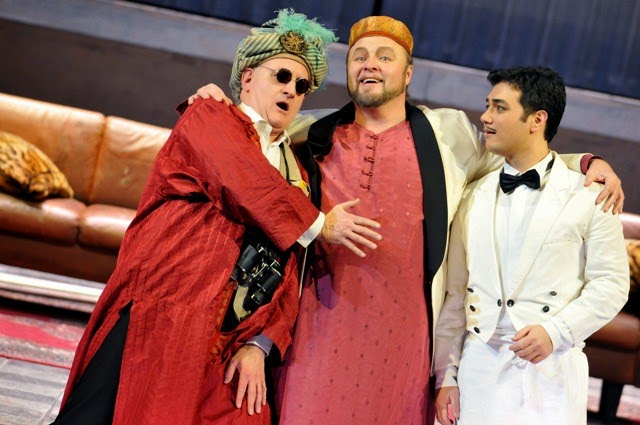
Oleg Bryjak, center
A quick throwback Thursday post on two fronts. Firstly, remembering the bass-baritone, Oleg Bryjak, who was among the 150 passengers on the Germanwings flight that crashed in the French Alps on Tuesday.  I had the chance to sing with Oleg back in 2010 during a production of Rossini's L'Italiana in Algieri at the Deutsche Oper am Rhein.  Oleg was a wonderful colleague - smart, funny, and an incredibly strong singer with an impressively agile and powerful voice, he was truly fearless on stage. All of the news about this Germanwings plane is more disturbing and upsetting with each update, it's hard to digest and leaves me bewildered, shocked, and just sad.

The above picture from the Deutsche Oper am Rhein in 2010 is a great testament to Oleg's amazing and uplifting stage presence. I hope he is resting in peace.

Secondly, and on a more uplifting note, another fearless musician, Pierre Boulez, celebrates his 90th birthday today.  On a day when so many horrifying revelations are coming to light about how so many people's lives were prematurely cut short on Tuesday, it only feels that much more poignant to celebrate the 90th birthday of this great man.  

I feel fortunate to have had the opportunity to work with Maestro Boulez - we performed some Stravinsky together with the Chicago Symphony in both Chicago and at Carnegie Hall a few years back. It was a monumentally inspiring week of music-making for me, and an experience I will always treasure. Because it was such a special  week, I feel lucky that it's documented so beautifully on recording.  NPR has a fantastic birthday tribute to him here.  As the ever-insightful David Robertson says about him at the end of the piece: "There are relatively few people who have this impact on the world, and Pierre is definitely up there among the major personalities of the 20th and 21st centuries."  I couldn't agree more.  Happy Birthday, Maestro.

Pierre Boulez


Wednesday, February 25, 2015

Old Lutes

See how happy he is, playing his lute?

The text of the second song in Britten's Songs from the Chinese, 'The Old Lute', which Eliot Fisk and I performed recently at the Menil Collection with Da Camera of Houston, has been nagging at the back of mind since our concert a few weeks ago. 
The Old Lute

Of cord and cassia-wood is the lute compounded;
Within it lie ancient melodies.
Ancient melodies weak and savorless,
Not appealing to present men's taste.
Light and colour are faded from the jade-stops;
Dust has covered the rose-red strings.
Decay and ruin came to it long ago,
But the sound that is left is still cold and clear.
I do not refuse to play it, if you want me to;
But even if I play - people will not listen.
How did it come to be neglected so?
Because of the Ch'iang flute and the zithern of Ch'in.

"But even if I play - people will not listen."  I find it somewhat cheeky of Britten to have chosen this poem to set to music - it is, of course, one of the most beautiful songs out the cycle of six, and one can't help but feel as though he is poking fun at 'present men's taste' somehow.  Again - it also seems somewhat contradictory to his artistic philosophies, as he spearheaded a movement of British composers to look backwards - his music was profoundly impacted by the music of Henry Purcell and John Dowland.


Certainly, it’s because my most recent album released on Avie records last week is full of songs by composers (lute-players, even!) who have been dead many hundreds of years.  Perhaps also it's because a friend and colleague posted this article about declining arts audience numbers to his Facebook wall the other day, that I find myself wanting to debate the poem, which has become some sort of metaphor for the so-called 'death of classical music' in my mind.  Needless to say, I found it ironic that we performed the song a few weeks ago in front of a packed audience.

This past summer, my partner was doing a bit of work for the Berkeley Festival and Exhibition, a biannual early music festival that takes place in Berkeley, CA.  As a result, I was able to attend the opening concert of the Festival - a concert of 15th century music for shawms, period bagpipes, recorders, and sackbuts performed by the ensemble, Ciaramella. The thing I found most fascinating and shocking about the performance was that the hall in which this concert was being held was packed to the gills with the most enthusiastic audience members.  There was even one particularly excited woman who was wearing a 'Got Shawms?' t-shirt.

Who would have thought there was an audience for shawms and 15th-century counterpoint?  Most people I know don't even know what a shawm is.  Yet, there we were, sitting in a completely full house - full of people who not only knew what shawms were, but were legitimate fanboys and fangirls of the ancient instrument, cheering with the same level of gusto as pre-teen girls at a One Direction concert.  This was a clear demonstration to me that an audience can be truly built for any kind of music of quality.  

During that concert, I found myself thinking about the organization I co-founded four years ago with two, amazing colleagues in Chicago, Collaborative Arts Institute of Chicago, an organization that is committed to promoting art song and vocal chamber music.  Much like the shawm, most people I encounter who are not classical musicians do not know what an art song is.  As we have built CAIC up from scratch over the past four years, it has become increasingly evident that many people are simply not familiar with this surprisingly large niche of classical music, and I've found it requires a lot of explanation when trying to build awareness of our little organization and its mission to promote and protect this intimately beautiful corner of the classical music repertoire.  Nonetheless, like the early music movement built a brand new audience over the past 35 years, CAIC, too, has continued to grow in Chicago – our audience numbers expanding healthily season after season. Listening to the shawms drone on and looking around at that enthusiastic and sold-out audience last summer, I felt like I was seeing what is possible with passionate advocacy and strong commitment to spreading the word about great music and music-making.  I found myself optimistic for the future of CAIC, as well as the future of classical music, in general.

It is not infrequent that when putting together projects or discussing the subject of recitals or repertoire with many people on the administrative side of our industry, I hear the words: “Oh, that won’t sell.”  These words really disturb me to my core: Underlying this defeatist statement is the belief that, even if we play, people will not listen. They’re just not interested.  Instead, we should subscribe to the tried and true – look at past audience numbers, see what has been popular, and just keep repeating that formula. 

In a digital age which has inundated us with an infinite number of options of art and entertainment from which to choose, it’s not that people will not listen.  It’s that they don’t see the option amidst the dizzying myriad of choices.  If they aren’t seeing it, it’s not a matter of a lack of interest, it’s a matter of cultivating that interest through drawing in the potential listener, the potential audience-member.  In these less simple times in the media, that means advocating and advertising a bit more loudly, with more insistence, and more creatively.


The songs on my most recent album are structured so that when one listens to them in order, they tell the story of a young man who falls passionately in love for a woman and who is ultimately destroyed by the fire of that passion. Aside from feeling that the repertoire naturally lent itself to it, the main reason I chose to structure A Painted Tale so that it had a dramatic framework and told a story was because I wanted to draw attention to dramatic and emotional power of these seemingly simple songs.  I wanted those already familiar with these songs to hear them with fresh ears and in a different context.  And I wanted people completely unfamiliar with them to have a reason to pause when considering that dizzying myriad of options as they browsed for something to listen to. 

In just the first week of its release, A Painted Tale debuted as one of the top 25 bestsellers on Billboard’s Traditional Classical chart. And while that is a tiny milestone in the larger scope of things, it gives me such great hope for the future of this amazing art form that is classical music.  

We are playing, and people are listening.


Friday, January 23, 2015

Michigan-inspired Serenades

Post-performance shot backstage with the amazing David Cooper

In a way, if one thinks about it, much of Britten's music after 1939 is, in a way, inspired by my home state of Michigan.  One night, in a hotel room in Grand Rapids, the relationship between Britten and Pears escalated from a professional friendship to the intense romance that knit the two together for the rest of Britten's life.  A quote from one of Pears' later letters to Britten:

"I shall never forget a certain night in Grand Rapids -- Ich liebe dich, io t'amo, jeg elske deg(?), je t'aime, in fact, my little white-thighed beauty, I'm terribly in love with you." 

Over lunch yesterday, David Cooper, the principal horn of the Dallas Symphony and my fantastic co-soloist for our performances of Britten's Serenade for tenor, horn & strings this weekend in Dallas discovered that we are both from Michigan. David is from Lansing, and I was raised in Ann Arbor.   Thus, it all comes full-circle and is a particularly Michigan-inspired weekend in Dallas.  

Yes, Michigan, indeed...

Tuesday, January 20, 2015

Pink Elephants

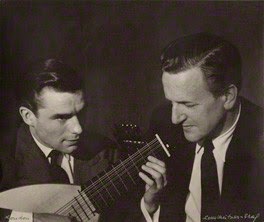
A week from tonight, I'll be performing with guitarist, Eliot Fisk, with Da Camera of Houston. The program is comprised of music performed by Sir Peter Pears and the famed guitarist, Julian Bream - who accompanied Pears with increasing frequency towards the end of Britten's life, the period when Britten wasn't anymore able to accompany Pears in recital due to the deterioration of his right hand after undergoing heart surgery in 1973.

Bream and Pears
The program opens with a song that I initially thought was just a simple silly song, but has over the past couple of months given me pause.  As I've studied it in preparation for our concert next week, I've found myself pondering the song much more than I ever thought it would, because of it's strange and uncharacteristic (for Britten) message.  The song, the opening song of Britten's cycle for tenor and guitar, Songs from the Chinese, is a strange call to ignore the cares of the world - an admonition to keep one's head down, and remain detached.

The Big Chariot 

Don't help - on the big chariot;
You will only make yourself dusty.
Don't think about the sorrows of the world;
You will only make yourself wretched.

Don't help - on the big chariot;
You won't be able to see for dust.
Don't think about the sorrows of the world;
Or you will never escape from your despair.

Don't help - on the big chariot;
You'll be stifled with dust.
Don't think about the sorrows of the world;
You will only load yourself with care.

While I can see Britten's attraction to the poem as a warning to protect one's innocence (and therefore one's unsullied, naïve happiness), the admonition to not think about the "sorrows of the world" strikes me as a strange one to draw the attention of someone like Britten, who was very much aware and conscious of the sorrows of the world around him.  A staunch pacifist and deeply thoughtful man, his work centered on so many socially-conscious themes, including the plight of the societal outcast and the futility and waste of war.  When thinking about the song in that context, there's something about the choice of the poem that strikes me as strange.

Mentioning this to Eliot yesterday in rehearsal, I also noted that the song is very much like the proverbial admonition to not think about the pink elephant in the room.  Each time I've come to study and practice it, I find myself thinking of nothing BUT the sorrows of the world. Whether they be the recent horrible terrorist attacks in Paris, the beheadings by ISIS in the middle east, or even the quadruple homicide that occurred the other night, just blocks away, while I was onstage performing Les Illuminations with the San Francisco Symphony (parade sauvage, indeed...) - I find myself pondering nothing but the world's woes as I sing it.

Perhaps this is part of what drew Britten to the poem in the first place?  Perhaps it appealed to him on multiple levels? The effort to protect fragile innocence?  The futility of that effort? Or perhaps he had simply come to think it actually was good advice, the world a no less dangerous, volatile, and threatening place than any previous era in human history?  I'm not sure.

Either way, I can't stop thinking about the pink elephant in the room.

Hear Ian Bostridge and Xufei Yang perform the piece below:


Friday, January 09, 2015

Beginnings / Illuminations

So...I only logged in one solitary post here in 2014.

The main reason for this is that 2014 was quite simply an incredibly busy year.  I mean that in the sense that it was both incredible and it was busy.  That said, I've not totally abandoned this blogging thing in any way whatsoever.  I simply took a bit of a hiatus.  Hiatus over.

I've had the subject of beginnings floating around in my head as 2014 turned into 2015 - it's a topic that frequently occupies my mind around this time each year.  Perhaps that is a large part of why I feel compelled to end this holiday from the blogosphere (do people even call it that anymore?).  It's the time of year for fresh starts, I guess.

Rehearsal with the San Francisco Symphony this morning
photo credit: Lolly Lewis
Speaking of beginnings, I begin my string of 2015 performances tonight here in my new home of San Francisco (layers upon layers of beginnings!) with a set of performances of excerpts from Britten's Les Illuminations with the San Francisco Symphony in its new experimental performance space, Soundbox (yet another beginning).

Britten composed Les Illuminations in 1939, during a heady, tumultuous, and life-changing time in his life, as well as in the world at large. With the world descending into violence and upheaval around him, and Britain being pulled into World War II, it was during this time that he crossed the Atlantic for the first time, following W.H Auden and Christopher Isherwood to the US.  It was also during this time in America that Britten's relationship with Pears transformed from a professional friendship into the romantic partnership that would last until his death in 1976.  The seventh song of the cycle (which we're unfortunately not performing on this weekend's program), Being Beauteous, is even dedicated to Peter Pears.

Each time I return to a familiar piece in my repertoire (which Les Illuminations is, for me), I find new layers of meaning open up to me upon revisiting it.  This occurs for a variety of reasons, mostly ones that have to do with marinating, time, and age.  This time is no different.

Arthur Rimbaud
It's not difficult to see why Britten was attracted to the poetry of Arthur Rimbaud, who's poetry comprises the texts of Les Illuminations, during this time. Rimbaud's poetry reads much like an acid-trip - he views the seemingly mundane world around us through a haze of wonderment, insanity, and eccentricity.  Cities and the people and things which inhabit them are seen as the gods and supernatural creatures of Greek mythology - the world is a wild and divine place, and these things which we normally take for granted are suddenly fantastical, beautiful and monstrous.  With the home he knew in Great Britain and Europe seemingly falling into chaos as Hitler pushed towards another world war, and traveling around a foreign country far from home, it's understandable why he was drawn to these works.  His world was turned upside-down, surely almost feeling like a surreality rather than a reality.

Thinking about this context in which he composed these songs, it feels timely to be singing such pieces about the savage and beautiful world in which we live.  With the horrifying terrorist attacks in Paris these past few days all over the news, the world still seems like a savage and bewildering place.  On a more personal level, my new home city, San Francisco, is also a strangely beautiful place: singing these songs this time, I find myself thinking a bit about the sense of wonder that I experience every time I look out at the Bay and its bridges, or the savage parade of characters that one passes by in the Castro every day.  

There is one phrase that Britten was first drawn to when composing these songs, which repeats multiple times throughout the cycle:

J'ai seul la clef de cette parade sauvage

"I, alone, hold the key to this savage parade"

This is a bold statement for Britten to fixate on, yet, again, an understandable one.  Here he was: a stranger in a strange land, a pacifist in a violent maelstrom, a gay man in a straight world...and an artist.  An artist looking in from an outside perspective.  In a way, it seems like Britten is making a declaration about himself as an artist here.  As if he is saying, from here on out, this is how I am going to define my work - this is the beginning of a new chapter in my music.  Listen up.

As beginnings go, I must say, it's an impressive and a beautiful one.  I'm really grateful to get to perform parts of it tonight.

Tuesday, March 18, 2014

Travel and Bigotry

A post from Mark Twain today (thank you to my FB friend for posting it and drawing my attention to it) - I couldn't agree more...


Image source is here.


Saturday, December 28, 2013

Took the Words Right Out of My Mouth


"…when I find the singing itself more moving than the truth which it conveys, I confess that this a grievous sin, and at those times, I would prefer not to hear the singer."
- St. Augustine

Words I can get behind.

Friday, December 06, 2013

Pathétiques & Serenades: A Meditation on the Varieties of Gay Experience

Pyotr Ilyich Tchaikovsky

This past weekend in Kitchener-Waterloo, I had the unusual pleasure of being able to sit out in the audience to enjoy the second half of our concerts, as my performing duties were done as soon the program hit halftime.  Led by their music director, Edwin Outwater, the Kitchener-Waterloo Symphony played Tchaikovsky's 6th Symphony, the 'Pathétique', after intermission - a piece I had not really listened to intently in quite a long time.  It actually happens to be one of the last pieces I played in my youth orchestra in Detroit before permanently putting my violin back in its case, so it holds a very special place in my musical heart.  I relished the opportunity to enjoy a live performance of it after singing Britten's Serenade for Tenor, Horn, & Strings at the end of the first half of the program.  However, as I listened the Symphony unfurl and reminisced about days past in which I let my teenage-angst express itself freely as I played impassioned and tortured melodies high on my violin's G-string in the symphony's final movement (an emo-joy that only other angst-ridden teenage violinists will truly understand),  I found myself listening to the piece with slightly different ears than I expected.

Beyond its sheer musical brilliance and heart-wrenching beauty, the Pathétique is legendary also for the fact that Tchaikovsky conducted its premiere just 9 days before dying, perhaps intending his final symphony to be a musical suicide note.  As I listened to the beginning of the haunting last movement, it dawned on me just how gay the evening's program was - seminal works by two great gay composers juxtaposed against each other, with some thematic similarities, and yet starkly different.  The two composers' biographies have many commonalities on the surface: Both were greatly respected and quite famous composers within their respective lifetimes, both were officially recognized by a great many international institutions as well as their respective homelands' monarchs for their work, both were gay men living in times when homosexual activities were illegal.

While both composers' works on the program explored themes relating to death, Tchaikovsky's struck me as so much more anguished - the rawness, brutality, and depth of his depression so unapologetically apparent and there for all of us to witness and experience with him.  It then struck me how different these two composers' lives were, too. Here I was listening to what was quite likely a lonely and tortured gay man's symphonic goodbye to the world, and I had just performed a piece that Britten had written for his life-partner of 35 years.  The dichotomy could not have been more striking - one man had lived a life struggling with depression, unable to allow himself to live openly with any real lover or to develop any type of romantic connection fully in any sort of lasting or deeply fulfilling way, while the other spent most of his adult life with a man who was not only his creative muse, but also the love of his life.  One man quite likely committed suicide, the other died of natural causes in the arms of his lifelong lover. There is a darkness to both composers' works, certainly, but in Tchaikovsky's symphony, personal anguish and inner conflict pour out because they have no other outlet, while Britten's Serenade is music that is inspired by love - a love that was known, accepted, and largely supported in his own wide-reaching community.  In the last song of Britten's Serenade, which is perhaps the darkest moment of the orchestral cycle that explores the various stages of night, the singer welcomes sleep and then begs to never to wake again, asking for the "casket of his soul" to be sealed.  Yet, the solo french horn sounds the call of a distant sunrise just after - a musical gesture that I take as a sign that he will wake up again and life will go on - the cycle will begin again anew.  Tchaikovsy's Pathétique ends with a heartbeat figure in the basses that gradually slows, and then simply stops.

In a year that has seen so many giant steps forward for the gay community here in the US, and so many setbacks and violence against the gay community abroad, the juxtaposition of the two pieces was particularly moving.  How much we have evolved - the evening's concert was conducted by a man who had just happily married his partner in Hawaii in front of their family and friends just weeks before our concerts last weekend. Yet, how much remains the same - gay teen suicide still abounds, making organizations like the Trevor Project still necessary.

While it's such a gift to have such beautiful music in our midst, how tragic it is to think of the abuse and struggles we still endure just to be able to love freely.

My favorite recording of the Pathétique - Eugene Ormandy with the Philly Orchestra.  
Movement 4 - Adagio lamentoso:

Thursday, November 28, 2013

Happy Thanksgiving

I'm in Canada for the weekend, so will miss out on the American Thanksgiving fun, but that doesn't leave me any less thankful for the lovely friends who keep posting this photo from www.thecountrycook.net:


Happy Thanksgiving to everyone back at home. Hope you are eating lots of Turkey. And stuffing. Yes, screw gluten-free for the day and live large.  No pun intended.

Friday, November 22, 2013

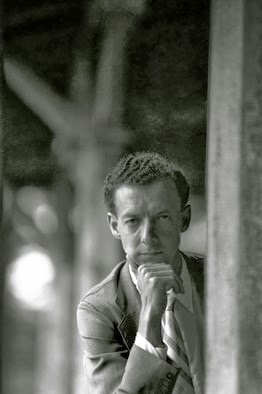
Britten 100


A lot of critics and music-journalists often decry the use of anniversaries as programmatic crutches upon which to wheel out the music of composers and fill out their season performance calendars.  Just about all of them have conceded, though, that in the case of Benjamin Britten and this centenary year of his birth, there is good reason to fête this man who was one of the 20th century's greatest composers, as his music is quite underserved outside of his native land.

Since I began my own personal project exploring Britten's music back in 2006, I've been repeatedly told time and time again that "Britten doesn't sell".  What has been gratifying about this centennial year has been watching presenters and musicians alike stop thinking to themselves "Britten doesn't sell" and actually get out there and start selling Britten.


The irony, of course, is that what compels me so much about Britten's music is that it does, indeed, sell. He has the power to touch an audience in ways that few other composers are able.  I've seen this time and time again as my various colleagues and I have watched audiences laugh, cry, and gasp during our recital programs of his music.  I was again reminded of the huge emotional impact his music has last week, during a sold-out performance of his War Requiem with the Baltimore Symphony in Strathmore.  Watching people's eyes flood with tears as the piece unfurled, the traditional latin requiem mass angrily/sadly/disbelievingly juxtaposed against the poetry of the killed-in-combat, World War I soldier-poet Wilfred Owen, it was overwhelming to experience the power of his music - just as impactful as any other composer of the "standard" classical music repertoire.  Perhaps more-so, in some ways.  I hope that the great world-wide efforts to program his music this year extend beyond this centenary, and that we continue to experience and explore his music more regularly.  This is timeless music for everyone everywhere - powerful, meaningful and beautiful music that must continue to be played, presented, and heard.


In addition to his music, I think that perhaps the most important aspect of the occasion of this centenary has been the opportunity for us to get to know the man, as well as his music.  Britten was, simply put, and extraordinary human being, and in getting to know him and the biography of his life over the past few years, I have found a hero in him.  Living as a gay man during a time in which homosexual acts were illegal, he not only lived openly and with integrity, but also had the audacity and courage to let his sexuality and his relationship with his life partner of Peter Pears inform his work, creating some of the most beautiful music of the 20th century.  Beyond his relationship with Pears, Britten forged an extraordinary community of incredible individuals and artists around him, who also inspired him. Working together with these people, he set out to change the world around him through his art.  He not only composed great works that explored important themes (such as the War Requiem and Still Falls the Rain, which directly challenge humanity to consider the horrible atrocities we commit upon each other), but also created new venues and platforms for our art-form to flourish and grow (like the Aldeburgh Festival and the English Opera Group), and creatively invented new ways for young people to experience and learn about music (like his opera Noye's Fludde).  He used his music to engage communities not only in a dialogue and meditation about the nature of being human, but also brought them together, fostering a stronger sense of fellowship and a greater appreciation for the arts.

Beyond the simple fact that Britten would have turned 100 today, celebrating Benjamin Britten could not be more timely - as we classical musicians struggle to find our footing in the 21st century, we could all take a cue from his willingness to innovate and engage.  We could all stand to model his keen awareness of the power that music and musicians have to knit communities closer together, and to change not only our own lives, but also the lives of those around us for the better.


A very happy 100th birthday to Mr. Britten, wherever he may be celebrating today in the afterlife.  Our world is a richer and more beautiful place because of you and your work, and I hope we can all take a cue from your work and life as we forge ahead with our own.

Thursday, November 21, 2013

Birthday Week 2


NPR Music kindly invited Sivan and I to join their Britten Centenary celebrations this month for their Field Recordings series.  While Britten was living in the US in the late 1930s and early 1940s, he lived for a while in Brooklyn in a group house that boasted such roommates as W.H. Auden, Paul Bowles, and even Gypsy Rose Lee.  A colorful crowd, to be sure…

NPR thought it would be fun to evoke the modern version of that Brooklyn bohemian-ness that Britten lived during his American sojourn by hosting a house concert at a modern-day group house in Brooklyn.  

One day to go.  Happy early 100th, Mr. Britten.


Wednesday, November 20, 2013

Birthday Week 1


A belated thank you to the very sweet and generous audience member at Spivey Hall in Atlanta the week before last who thought to bring this all the way back from their trip to London for me.  It's proudly displayed on my backpack. 

Happy early 100th, Mr. Britten.

Friday, November 15, 2013

Post-Mortem New York City Opera - What Now?

Back in September, just before the post-New York City Opera era dawned, I was in the midst of the maelstrom of mounting Collaborative Arts Institute of Chicago's second annual Collaborative Works Festival.  One of the things I had programmed on the final concert of the festival was a set of Beethoven folk song arrangements for singers and piano trio, to be performed by myself, soprano Kiera Duffy, and some of the members of eighth blackbird, the highly-acclaimed ensemble that normally specializes in new music.

After a Beethoven rehearsal, the violinist and violist of the group, Yvonne Lam, and I were discussing the effect performing new music has had on our work with 'old' music - the music of what we classical musicians consider the 'standard' repertoire. Mozart, Bach, Brahms, Beethoven, etc.  Yvonne echoed a sentiment that I have often thought of performing new music, something that I briefly discussed in an interview in Toronto recently: "...doing a lot of new music makes you look at the rest of music in general with fresh eyes, because you're so concerned with how to communicate what's written down on the page to an audience that you suspend all sense of expectation. You look for the reason and purpose behind everything, so that every gesture is intentional."

I've been thinking a lot lately about how the classical music world, in general, could benefit from this type of thinking.

For anyone who has been living under a rock lately, it's been a rough go for our industry as of late.  Two really sore and greatly discussed situations somehow seem emblematic of the struggles we have been experiencing.  Having just celebrated its 110th birthday, the future of the musically head-less Minnesota Orchestra remains extraordinarily unclear and seemingly hopeless after more than a year of a lock-out of the musicians by the orchestra management. Also, the New York City Opera has closed its doors and filed for bankruptcy.

The NYCO situation has been the fodder for much gnashing of teeth in the press, and rightly so.  The world have lost one of the most important platforms for the art form of Opera for the past 70 years.  Much has been written reminiscing about memories of the past, documenting its final moments, as well as analyses of what went wrong and who exactly is to blame.  It makes sense - we are grieving an epically tragic loss, and it is natural for us to go through these stages of grief: denial, bargaining, anger, depression and acceptance.

I've had to go through my own grieving process with the collapse of the NYCO.  The most immediate sting is that I was slated to sing the title role in the company's next scheduled production, J.C. Bach's Endimione.  This is obviously not happening now, and I feel most of the feelings that I listed above quite acutely.  I'm sad that this fascinating project is not to be, and that I have lost this opportunity to perform this beautiful and largely unfamiliar music.  I read all of the accounts of what went wrong and think, "if only…". I'm angry that I signed, in good faith, a document that bound me to the company for that period, turning down numerous (and at times lucrative - both artistically and financially) offers for that period, only to be left with a two month hole in my normally (thankfully) over-full calendar.  I also have accepted that this is the way that the proverbial cookie has crumbled, and I am now trying to figure out what to do with myself with this unexpected period off, grateful that this is just a blip on the screen of my life and not a complete system-fail requiring a reboot, like it could be and has been for so many others.

My own history with the company is somewhat mixed.  While the company gave me my first operatic opportunity in Lincoln Center shortly after I left the Houston Grand Opera studio as Damon in their exquisitely beautiful production of Handel's Acis & Galatea, this NYCO cancellation is actually the second that I've had to grapple with - I was scheduled to perform Nemorino in a production of L'elisir d'amore that the company was planning to tour through Japan back in 2009.  The tour was cancelled because of the company's inability to raise or allocate the funds necessary to take the company to Asia.  Thankfully, those plans were abandoned in a timely and responsible fashion, long before being announced or production had begun.  Regardless, I've always been grateful to the company for offering me the exciting opportunity to make my operatic debut in New York City.  I learned valuable lessons during my short time there, and, perhaps most importantly, I had one of the most special and enjoyable operatic experiences of my career during that production.  When things were going right there, it was a great place to be.

So why did I start off this whole diatribe with that little vignette about a short, post-rehearsal conversation in Chicago?  Like performing new music (as well as the music of Benjamin Britten this past year) has shown me, I think it's time to start looking at our arts organizations in a different way - like new music, with fresh eyes. As our venerated institutions become older and more established, it is easy to begin taking their existence for granted.  The demise of the New York City Opera should be a lesson and warning to us all in this regard.

I firmly believe that the sole purpose of any artist and any arts institution is to serve the communities around them. This week, I am in Baltimore to perform Britten's War Requiem with the Baltimore Symphony.  The War Requiem, is the ideal example of this idea that our art form exists to serve the communities around us.  The piece, composed for the consecration of the rebuilt Coventry Cathedral, which was destroyed during World War II, was written as a piece of healing. It is a cry for reconciliation, and for peace.  Even though its poetry was written to decry World War I, and the music composed to grieve the losses of World War II, the piece remains just as relevant today as it ever has.  We still live in a world in which we send our youngest and brightest off to be killed in war - we still have fallen soldiers to mourn and violence to contemplate.

As part of my work with the Symphony, I have been asked to spend time talking with various classes of high school and middle school students about the piece.  In speaking about this piece with these young people, I am reminded of how unfamiliar all of the classical music repertoire is becoming to much of the American public.  This music is less and less frequently taught as part of a young person's general education.  The most exposure many people get to classical music is the occasional snippet of Carmina Burana in a car commercial or the talented young girl singing Puccini's 'O mio babbino caro' on Insert-Name-of-Country-Here's Got Talent.  It is shocking to me in my travels how often a city's residents are completely unaware that their home boasts its own Symphony or Opera, let alone a chamber music series.  If this is the case - why do we continue to operate with the assumption that everyone is as familiar with our art and its institutions as we are?  We've spent lifetimes training to achieve the level of musicianship and administrative expertise we need in order to bring this music to the people around us.  We've forgotten that we are specialists.  We've lost sight of the the fact that we exist to educate.

We must stop taking for granted that all people know this beautiful, rich repertoire that is 'Classical Music'.  We must even stop taking for granted that everyone is familiar with us as performers and institutions - many people don't know who we are, what we do, and why we do it.  Our media marketplace is too crowded for us to take that for granted anymore.  We must make sure that every gesture we make is intentional and not a motion that we simply take for granted because it's something we've always done or just a desperate act of survival.  We must engage the communities around us beyond begging for them to dig us out of our grave.  We must look at why and how we are relevant, and how we relate.

It is our responsibility as classical musicians to enable the communities around us to experience and discover this beautiful, potentially life-changing music.  In doing this, we will engage these communities in a dialogue - reminding both ourselves and everyone around us why we are relevant, why what we do is important, and perhaps in the process bring our increasingly divided communities together.

This is not just the job of us performing artists (who must examine our programming and artistic vision) but also of the boards and administrations of these organizations, as well.  Just as artists exist to serve the communities around them, it is the responsibility of those communities to support and protect them.  In this sense, we are all guardians of this music.  We are all artists, in this way.


Thursday, October 31, 2013

Happy Halloween

It's a strangely wet and humidly spooky day here in Toronto. 


Wednesday, October 30, 2013

Canadian Rehearsal

The Toronto Symphony, Toronto Mendelssohn Choir and our fearless leader, Peter Oundjian.

The Roy Thomson Hall Mothership hovering above the stage. 

Tuesday, October 29, 2013

Monday, October 28, 2013