Monday, June 18, 2012

Robert's Romance and the 19th Century iPod

My latest guest post at the Ecstatic Living Room blog...


At a concert I gave with the pianist, Jeremy Denk, about a week and a half ago in Chicago, Jeremy described the piano as the "iPod of the 19th century".  In the days before iPods, CD players, cassette tapes, 8-tracks, record players, and phonographs - the days during which the majority of the standard classical repertoire was written - if one wanted to hear some music outside of the concert hall, one had to make music themselves. Pianos were the primary way of doing that and experiencing in one's home.

My partner and I recently purchased a new upright piano for our apartment, and it has been a fun opportunity to pretend like we're back in the 19th century, playing our 19th century iPod in our home and making music together, mostly sight reading through songs as we laugh at our silly reading mistakes along the way.  Perhaps because Jeremy and I were so focused on Schumann for the past couple of weeks in preparation for our concert in Chicago, my partner and I have also been exploring Schumann's many songs, some of which I think are perhaps some of the most beautiful songs ever written.

In one of the more romantic stories in Classical music history, after a long and dramatic courtship, Robert Schumann finally married his great love Clara Wieck in 1840.  The two were madly in love, but were prevented from marrying for a long time by Clara's father, who disapproved of Robert, thinking him an unsuitable since he was a poor composer.  As the tension of their protracted and fraught engagement finally released, and they were able to be married, Robert suddenly had a flood of songs pour out of him - he composed 168 songs in 1840 alone, and in the process elevated the whole art form of song to an entirely new level.  Among the songs he composed that year are his famed song cycles Liederkreis Op. 24 and Liederkreis Op. 39Frauenliebe und Leben (Woman's Life and Love), and his incredibly beautiful song cycle about a poet's infatuation and break up with his love, Dichterliebe (which Jeremy and I performed last week in Chicago).

In a ridiculously romantic gesture, Robert grouped together the first 26 songs he composed that year into a collection entitled Myrthen and gave them to Clara as a wedding present.  The first song, Widmung (Dedication), is perhaps one of his most beautiful compositions.  While I don't understand why there are Jellyfish floating around in the backgroud of this video, here is one of my favorite Lieder singers performing the song:


Du meine Seele, du mein Herz,
Du meine Wonn', O du mein Schmerz,
Du meine Welt, in der ich lebe,
Mein Himmel du, darein ich schwebe,
O du mein Grab, in das hinab
Ich ewig meinen Kummer gab.

Du bist die Ruh, du bist der Frieden,
Du bist vom Himmel mir beschieden.
Daß du mich liebst, macht mich mir wert,
Dein Blick hat mich vor mir verklärt,
Du hebst mich liebend über mich,
Mein guter Geist, mein beßres Ich!

- Friedrich Rückert


You my soul, you my heart,
you my bliss, o you my pain,
you the world in which I live;
you my heaven, in which I float,
o you my grave, into which 
I eternally cast my grief.
You are rest, you are peace,
you are bestowed upon me from heaven.
That you love me makes me worthy of you;
your gaze transfigures me;
you raise me lovingly above myself,
my good spirit, my better self!

Imagine getting that as a wedding present from your brand new husband -  we should all be so lucky...

I've linked to some of my favorite recordings of each of these cycles above.  If you're in the mood to immerse yourself in the results of Robert Schumann's romantic high in 1840 and experience the products of his honeymoon bliss, check out one of those recordings above.  In case of you are curious, here's a recording one of the songs that my partner and I have fallen in love with during our explorations at our new piano.  It's called Schöne Fremde (Beautiful Foreign Land), from Liederkreis Op. 39.


Es rauschen die Wipfel und schauern,
Als machten zu dieser Stund
Um die halbversunkenen Mauern
Die alten Götter die Rund.

Hier hinter den Myrtenbäumen
In heimlich dämmernder Pracht,
Was sprichst du wirr wie in Träumen
Zu mir, phantastische Nacht?

Es funkeln auf mich alle Sterne
Mit glühendem Liebesblick,
Es redet trunken die Ferne
Wie vom künftigem, großem Glück.

   - Joseph von Eichendorff


The treetops rustle and shiver
as if at this hour 
about the half-sunken walls
the old gods are making their rounds.
 
Here, behind the myrtle trees,
in secretly darkening splendor,
what do you say so murmuringly, as if in a dream,
to me, fantastic night?
 
The stars glitter down on me
with glowing, loving gazes,
and the distance speaks tipsily,
it seems, of great future happiness.

Monday, April 30, 2012

Mozart's Perfection and Imperfection

In honor of my first performances of Don Giovanni here in Atlanta, a reposting of my recent post at the Ecstatic Living Room on some of Mozart's Operatic Arias:


As I’ve started rehearsals for my very first production of Mozart’s Don Giovanni this week in Atlanta, I’ve been thinking a lot of about Mozart lately.  At every break in rehearsal, someone inevitably sighs, “oh….this music is so incredible…”, and it’s gotten me thinking about how Mozart was truly at his best when he was writing opera.  His music for the theater is perfectly balanced; it celebrates humanity’s perfection in its imperfection.  When you look at all of these situations and characters, they are so flawed and incredibly messy – yet Mozart’s music is so beautifully balanced. His music praises human imperfection, as if he knows that the beauty of being human is found in the patina of all our flaws.  It’s messy and clean all at the same time.
Being in this Mozart frame of mind, I thought this might be a good opportunity to share some of my favorite Mozart arias here.  Incidentally, they are also some of my favorite operatic arias, period.
As I am currently in rehearsals for Don Giovanni, why not start with one of my favorite moments – Leporello’s aria, Madamina, il catalgo è questo.  At this point in the opera, Donna Elvira, a Spanish noblewoman who has been seduced and then dumped by Don Giovanni, has followed (stalked?) Giovanni all the way from Spain.  Giovanni manages to evade her, leaving his servant Leporello to tell her the truth – that she is just one of thousands of women who fill his little black book of conquests.  Listening to Leporello, Don Giovanni sounds like quite the impressive stud…or a sex addict.
LEPORELLO:
My dear lady, this is a list
Of the beauties my master has loved,
A list which I have compiled.
Observe, read along with me.
In Italy, six hundred and forty;
In Germany, two hundred and thirty-one;
A hundred in France; in Turkey, ninety-one;
But in Spain already one thousand and three.
Among these are peasant girls,
Maidservants, city girls,
Countesses, baronesses,
Marchionesses, princesses,
Women of every rank,
Every shape, every age.
With blondes it is his habit
To praise their kindness;
In brunettes, their faithfulness;
In the white-haired, their sweetness.
In winter he likes fat ones.
In summer he likes thin ones.
He calls the tall ones majestic.
The little ones are always charming.
He seduces the old ones
For the pleasure of adding to the list.
His greatest favourite
Is the young beginner.
It doesn’t matter if she’s rich,
Ugly or beautiful;
If she wears a skirt,
You know what he does.
Next, let’s move to perhaps one of Mozart’s most famous arias: “Der Hölle Rache kocht in meinem Herzen” from The Magic Flute.  I’d venture to say that it’s one of his most favorite compositions simply because it is fierce music – it’s insanely dramatic and when you hear a woman sing it (or a boy), its just simply astonishing that a human voice can make those sounds.  At this point in the opera, the Queen of the Night is imploring her daughter Pamina to murder the high priest Sarastro, threatening to disown her if she doesn’t follow through.  Whenever I see this, I always hope for Pamina’s sake that she has a good therapist waiting for her in the wings, so she can work through all the inevitable mommy issues she is bound to have after hearing that aria being screamed in her face.  Here’s my favorite recording of this aria, sung by soprano Edda Moser:
QUEEN OF THE NIGHT:
Hell’s vengeance boils in my heart;
Death and despair blaze around me!
If Sarastro does not feel the pain of death because of you,
Then you will be my daughter nevermore.
Disowned be forever,
Forsaken be forever,
Shattered be forever
All the bonds of nature
If Sarastro does not turn pale [in death] because of you!
Hear, gods of vengeance, hear the mother’s oath!
My third favorite aria is perhaps my favorite aria that Mozart ever wrote, “Un’ aura amorosa” from Così fan tutte.  At this point in the opera, the soldiers Ferrando and Guglielmo have placed a bet with Don Alfonso on their girlfriends’ fidelity – in order to test their girlfriends’ faith and love, they disguise themselves as traveling Albanian soldiers and attempt to seduce each others’ lovers.  Sure that Don Alfonso is going to lose, Ferrando daydreams about what it will feel like when this prank is over, and enjoys the beauty and strength of the love he feels.  It’s perhaps one of the most tender and sweet moments ever composed in opera.
FERRANDO
A breath of love
From our treasures
Will afford our hearts
Sweet sustenance.
A heart nourished
On the hope of love
Has no need
Of greater inducement.

Thursday, March 29, 2012

Collaborative Works Festival


Today is an extremely exciting day for my colleagues at Collaborative Arts Institute of Chicago and I, as tonight is the very first concert of our first ever Collaborative Works Festival - our new, annual Festival devoted to the art of song and vocal chamber music.  My colleagues at CAIC and I have actually been dreaming of this Festival since 2005, long before CAIC as an organization was even an idea.  We have had this vision of building a showcase for the art of song and promoting this incredibly rich repertoire that we are so passionate about - from that vision, CAIC was born, and now, the pinnacle of that vision - the Collaborative Works Festival, is about to begin.  Below, you can read more about my thoughts on our vision for this annual series of concerts in my Artistic Director's note reprinted from this weekend's program.  Tonight is a major milestone for us at CAIC, and there will be much to celebrate.


Unfortunately, the life of the traveling artist forces one to miss many important milestones - it's the one aspect of this life in music that I find most difficult.  Tonight is one of those nights in which I have wished in vain that I could clone myself or divide myself in two, and somehow pull off the impossible feat of being able to be in two places at once.  When the opportunity arose to be able to present Martin Katz and Jesse Blumberg as our inaugural festival artists, we at CAIC knew that this was not a chance to be missed. Unfortunately, though, due to the complexity of calendars, I wasn't able to coordinate my own schedule to match with theirs in order to be there for this momentous event.  So, while I will be singing Bach with David Robertson and the Saint Louis Symphony this weekend, Jesse and Martin will be launching this Festival which has become so close to my heart and has become one of my primary passions.  My heart is with them and my colleagues at CAIC this weekend, and I am forever grateful for their integral part in getting this vision of ours off the ground in such classy and spectacular style.  


Tickets are still available for both concerts of the Festival, which are both at the the Cindy Pritzker Auditorium at the Harold Washington Library in downtown Chicago, and there are still spaces available for tomorrow night's Master Class on Schubert songs with Martin Katz, which will be held at the Pianoforte Salon of the FIne Arts Building on Michigan Avenue.  If you are in Chicago, please be sure to catch both of these amazing artists perform these all too rarely performed masterpieces, and celebrate the launch of this new Chicago tradition with us.  I will be celebrating with you all in spirit.


A NOTE FROM THE ARTISTIC DIRECTOR OF CAIC:


The simple act of a human voice telling a story through song has a way of piercing to the core of our hearts, inciting reactions from laughter to tears. Something aboutadding music to text makes the story a universal one: Music's universal language draws us together, allowing us to hear someone sing their story and feel, "Oh my gosh - that's me...I've lived that, too..."

While the grand forms of musical theater and opera are incredibly powerful and moving, they can feel like blockbuster movies, sweeping up their audience with the staggering weight and momentum of the many dramatic elements involved: orchestras, soloists, choruses, sets, costumes, wigs, make-up, imaginary fourth walls, and gigantic theaters make for a big show. When it comes to songs, there are only the performers and the audience, and the atmosphere created is one of direct communication and personal expression. For me, a song is a special type of conversation that gives me the opportunity to see inside the performers' heart and soul. Because of its direct nature, the art song has an unlimited potential for real vulnerability and intimacy in the relationship created between performers and audience.

As powerful as the song is, it is an art form in peril. There are so few that present performances of song, and even fewer that seek to preserve the art form and cultivate an audience for it. Part of the mission of Collaborative Arts Institute of Chicago is to promote the art of song and vocal chamber music. It is our passion for this niche of the vocal repertoire that inspired Shannon, Nicholas, and me to pursue lives in music. We have experienced the transforming power of song as both performers and as listeners, and our lives have been forever changed for it. CAIC has created the Collaborative Works Festival to be Chicago's showcase for this repertoire, and we are excited to be pursuing this part of our mission with such fervor. This music is too powerful to be ignored or forgotten, to be left unplayed and unsung. It is music that is truly for everyone, and it should be enjoyed by all. It just needs more opportunities to shine!

I cannot imagine a more fitting way to kick off this annual Festival than with performances of Franz Schubert's song cycles. Schubert truly is the 'father of the German Lied', and his virtuosic song settings have inspired song composers of every generation and every nationality. This combination of performers is perfectly apt, as well. Martin Katz has mentored countless musicians in the performance and study of song, as well has having accompanied some of the world's most famous singers for nearly half a century. Jesse Blumberg has established himself as a leader of his generation in championing the art of song, both as a performer and a presenter; in 2007 Jesse founded the Five Boroughs Music Festival in New York City, which has become impressive platform for song and chamber music.

I sincerely hope you enjoy the 2012 Collaborative Works Festival's 'Epic Journeys'. We're excited to have you with us on the beginning of our own epic journey, as we inaugurate a new Chicago tradition!


Tuesday, March 13, 2012

A Passion for the Passions

I've been graciously invited to be a new regular contributor at the classical music blog, The Ecstatic Living Room.  Below is a preview of my first post there, about Bach's Passions.  If you enjoy the preview, please feel free to check out the rest of the post at the Ecstatic Living Room's site.  Also, take a moment to browse through some of my other colleagues' posts there.  It'll be a fun time, I guarantee it...


A PASSION FOR THE PASSIONS


Mardi Gras, or Fat Tuesday, just passed by us, so for much of the world, now that the copious alcohol consumption, Paczki eating, parading, and bead-necklace tossing is over, and Guys/Girls Gone Wild has enough flasher footage to finish their 19th installment in their series, Lent has begun. I was raised Greek Orthodox, and as a result, our Easter often tends to fall at a slightly different time each year, so I actually wasn’t raised with the tradition of Fat Tuesday. Instead, while the ideas behind the holidays are the same, Lent for us always began on Clean Monday – which entailed a day of strict fasting, and was much less fun than Mardi Gras, I assure you.
On the few times my mother insisted that we strictly fast in observance of Clean Monday, it was explained to my younger brother and I that the reason for enduring the throbbing headaches caused by our hunger pains was so that we could understand the sacrifice that Jesus made for our sins by allowing himself to be crucified. It was then explained to us that the idea of giving something up for Lent continues the meditation on this particular theme. Of course, this was lost on me as a child, and I just continued to whine about not being able to eat Chicken McNuggets for 40 more days.
For singers, the Lenten and Easter season (which I can hardly believe has arrived already – where does the time go?) proves to be a time in which there is a lot of extra work singing about the Passion of Jesus Christ, as well as the Easter Story in general. The pieces that seem to get the most traction around this time of year are Bach’s two Passions. While it is pretty clear that he wrote or at least drafted four versions of the Passion story (one for each gospel – Matthew, Mark, Luke and John), only two seem to have survived in a complete form to the present day: the Passions according to St. Matthew and to St. John. The way Bach conceived of both pieces is pretty extraordinary, and while they are clearly pieces of sacred church music that was not meant to be staged, both works are quite theatrical in scope. Each piece has a narrator – the Evangelist – who is like the voice of an angel, narrating the action of the story in a very simple, speech-like musical form called recitative. A baritone plays the role of Jesus in these recitatives in both pieces, and the chorus members play the other various characters in the story through their many choruses. Yet, for me, what are most compelling about both passions are the four soloists (a soprano, an alto, a tenor, and a bass) who comment on the action of the story as timeless, human observers with haunting and meditative arias. This story is one that many have heard told yearly in church – Jesus was arrested and tried under Pontius Pilate, sacrificed himself for our sins, was crucified, and was buried. The commentary of the soloists, though, is heartbreaking – relating the story to us as believers, meditating on what the various aspects of the story mean. It’s like listening to sermonizing on the lessons of the Gospel, but in a way that actually compels us to listen, and can actually move our hearts — unlike when we tune out the priest’s homily in church, patiently waiting for the offering tray to be passed our way and the post-church-service fellowship hour to begin...  (read more)

Monday, February 20, 2012

What's Important


There has been much talk (and screaming and shouting and general drama) about the plight of the New York City Opera over the past year or so.  I’ve heard musicians and singers debating hotly about it during rehearsal breaks, FaceBook pages and groups have been set up at which people write angry and pointed statements about whether City Opera should continue, and there has been much written about it in the press, as well.  As one of the many American singers who got an early break on the New York City Opera stage, I care very deeply for the company and the people who have devoted their lives to it.

On Valentine’s Day, I journeyed down to Brooklyn to see the company’s production of La Traviata, going not only show my support for the company, but also my dear friend Laquita Mitchell, who after years studying at the Manhattan School of Music and in the Houston Grand Opera Studio together, has become like a sister to me.  As I rode the train to the Brooklyn Academy of Music, I felt a bit of the usual resentment that it takes so long to get to Brooklyn from Manhattan (and, yes, I realize that I’m offending many Brooklyn-fans by saying that out loud…I just have yet to fully embrace the boroughs…forgive me!), and I tried to pass the time by listening to music on my iPhone, and watching the other subway riders around me.  Glancing at the time as my train rolled into Atlantic Station, I realized that I was a bit late, and sprinted up the stairs and around the corner to the theater, opening the doors to mass chaos.  BAM was so crowded, I could barely find the box office let alone the entrance to the theater.  People of various young ages and in various states of dress-up were milling around, desperately trying to find the end of the Will-Call line, jostling each other impatiently in an effort to get to their seat before the curtain rose.  I felt suddenly as if I was at something that was hip, cool, and vibrant, and despite my irritation at being pushed about in a crowd – I was overjoyed to see that there was a crowd there.  I took my seat, and I saw that the house was packed – there was barely an unoccupied seat anywhere to be found.  As I settled into my chair, waiting for the show to begin, I thought about all of the shouting and screaming about trying to shut the City Opera down, and how the Opera is a shell of it’s former self, replaying all of the debating and infighting that I’ve observed from afar this past year in my head. 

Just as the house lights dimmed, and the conductor made his entrance in to the pit, I heard the young couple behind me whisper to each other:
“Have you ever even been to an opera before?  
“No – I haven’t.” 
“Neither have I – and I’ve always wanted to go…I’ve always been curious to see what it’s like.” 
“Me too – this is exciting!” 
“It sure is!”
And then I thought – THIS is all that is important.  THIS is why we need a City Opera.  No matter where the show is. 

The conductor raised his baton, and the violins began the show…

Wednesday, December 28, 2011

Martin Isepp


A friend was saying to me recently over the holidays that it seemed to her in our current fast-paced age, true mentors are hard to come by.  In some ways, I felt a bit of truth to her words, and if that is truly the case, I feel incredibly lucky to have had so many people who I would consider mentors throughout my years as a musician so far.  One of the greatest of these for me would most definitely be the pianist, coach and conductor, Martin Isepp.

I’ve often said that my four summers at Marlboro saved my relationship with music.  After a few years of hustling to carve out a beginner’s foothold in the tough and competitive operatic world, I arrived for my first summer at Marlboro burnt out, somewhat jaded, and a tiny bit unsure why I was going there in the first place.  Hindsight being 20/20, when I look back at that version of myself standing perplexed and terrified at the threshold of my first, rustic dorm room on the Marlboro campus, I strongly believe that the main reason the fates had brought me to Marlboro that first summer was because I was starved for inspiration.  Martin was one of the main people in whom I found that inspiration which I so desperately needed.

Over the course of my four summers at Marlboro, I explored with Martin the many complex layers of the songs of Britten, Schumann, Vaughan Williams, Brahms, Wolf and Mozart.  As Martin guided me through the twists and turns of all this music over the course of our many sessions at Marlboro together, I came to understand that his approach to music came from a place of deepest respect and love for the art form.  A tough and demanding coach, he never let one note of music be poorly sung, nor one phrase pass by unexamined or unstylishly turned. Yet, despite being so rigorous and exacting, his manner was, for the most part, very gentle.  If he didn’t like something one did, he would sigh as if disappointed that you had broken his favorite piece of china and then begin to go about gently prodding the musician he was working with in a different direction, gradually cajoling them to approach the phrase or note in a way that would suddenly unlock the mysteries of the music at hand. At the end of these moments, the “eureka!” light bulb would shine brightly, and the cobwebs of confusion and musical befuddled-ness would disappear.  The music would flow again, and the composer’s intentions and the musical drama of the moment would suddenly be crystal clear.  Always expecting the best, and constantly pushing those that worked with him towards the highest levels of excellence, I found myself in our sessions reaching again for greater heights for the first time in years.  I experienced some songs I had known for years in a completely different light after bringing them to him – for instance, Schumann’s “Schöne Wiege” will never been the same for me after our sessions on Schumann’s Liederkreis, Op. 24.  Martin revealed the profound depth of the song's protagonist’s pain at leaving the town where he met his beloved by simply adjusting the tempo of the song in one of our sessions, transforming what I once thought of a simple, pretty, melancholy song into a richly layered, complex, heart-wrenching piece of music just as dramatic as any operatic aria ever composed.  After years of neglecting the world of Lieder and Art Song while running the beginner’s operatic rat-race, through our sessions together I rediscovered my passion for the music that made me fall in love with the art of singing.  At a time in my life when I felt that I was starting to lose touch with my wonder, respect, and love for music, Martin rekindled the fire inside of me, reconnecting me with the calling that pushed me to pursue a life in music in the first place.

The news of his passing on Christmas day is a true loss for our musical community, and he will be sorely missed.   As the person who delivered the sad news to me on Monday said, “it is difficult to imagine a person with greater integrity, musical instincts and knowledge, and kindness. There is quite simply, no replacement for him.”  I could not agree more.

Martin, I cannot thank you enough for the inspiration, encouragement, and mentorship you have given me and the musical world around me.  May you rest in peace, and may we remember you forever in our world of song.

Courtesy of YouTube, one of Martin's performances at Edinburgh - with Frederica von Stade: 


Sunday, December 25, 2011

Merry Ho Ho 2011

To all those celebrating the holiday today (and taking an online break from the festivities), a very Merry Christmas to you!


As my final concert of 2011 included an ondes martenot last week at Carnegie Hall, it only seems fair and hilarious to celebrate with these youtube performances of some carols on its sister instrument, the theremin:


Silent Night:


O Come All Ye Faithful:


Hark! The Herald Angels Sing:


And on a more serious note, here's a beautiful performance of one of my favorite carols:


Happy Holidays to all!

Sunday, December 04, 2011

The Rules

A few years ago, I was rehearsing with a pianist for an upcoming concert, and I couldn’t remember what the rule was regarding whether to approach a trill from above or directly on the note when singing a certain composer’s music.  I asked her if she remembered the rule, and she said to me, “I don’t do rules.”

While her response seemed hilariously rebellious at first, I came to see a lot of logic to her point.  Much like Italian cuisine, which varies so much from region to region, so do people’s ideas of “rules” in music.  Encounter an Italian from one region of Italy, they will tell you that unequivocally you do not use garlic when preparing a certain sauce.  Travel just an hour south, and ask an Italian from that region about said sauce, and they will tell you unequivocally that you MUST use garlic when preparing that sauce.  Both are equally convinced that they are telling you the rules, despite the fact that they are telling you the opposite.

Much the same thing happens in music, particularly when musicians speak of the music of the dead.  After my pianist friend’s comment above, this strikes me as also hilarious, because let’s be reasonable – how can we really know?  I always want to say, show me your time machine and let’s go talk to those composers.

Now I understand that we do know some information about how this music was performed – most composers that are in the standard canon of performed classical music have left writing and documented evidence of their tastes.  Rossini wrote often of his distaste for his singers ornamenting his music, and he is documented as being highly critical of what has become the standard, modern-day technique of tenors to carry our chest voices up to the very tops of our ranges.  Nevertheless, when was the last time you heard Una voce poco fa without any ornamentation or a tenor singing Count Almaviva without heroic high notes?  These things are generally accepted as “rules” today and are expected in performance.

Then again – these dead composers were once flawed, imperfect human beings, too, and often contradicted themselves.  Handel was also a bit critical of singers overly ornamenting his arias, but then again, you look at some of the ornaments he himself wrote, and you get a mixed message in terms of “performance practice”.  My colleague, Ann Hallenberg, showed me some of the ornaments he wrote for her arias in Ariodante while we were on a concert tour of the opera this summer, and I tell you, they are crazy.  Sure, they are beautiful and exciting to listen to, but they look slightly insane at first glance.

Handel’s Messiah is one of these pieces that is often subject to “rules”, yet interpretations of it widely differ. To say that the piece is performed in a wide variety of styles is an understatement, and it is performed in many different versions with different cuts and different singers singing different arias.  Just to give you a taste of the wide range of possibilities, here are two examples of the many ways the first tenor aria can be performed:


The first time a younger version of myself encountered a version of Messiah that didn’t conform to my expectations or the set of rules of the piece that I had in my hot-headed, young noggin, I reacted initially with a very closed mind.  But what I quickly noticed is that whether a particular style or version is to my taste or not, each one, when performed with conviction, brings out something new in the piece that I have never heard before.  I’ve sung the piece in so-called “authentic, period-style” performance with period instruments, and I’ve sung performances of the piece with modern-instrument orchestras that approach the piece with more of a romantic flair, and what I can say is that the piece is never the same for me.  This weekend with the Baltimore Symphony, I experienced yet another interpretation, and yet again, there were new aspects of the drama of the piece that the conductor brought out that I had never heard in the piece before.  The piece was yet again kept fresh for me – this is part of what I find so amazing about this music.  There is so much in it to be brought forth and emphasized, and there are so many ways to interpret it.  In the end, whichever "set of rules" the performers choose to subscribe to, the performer has to decide what is to their taste and commit to it.  The point isn’t the rules, but what it is that you want to say.


Just for fun, here's a video of one of my favorite moments in the piece:


Wednesday, November 23, 2011

Happy Thanksgiving Randomness

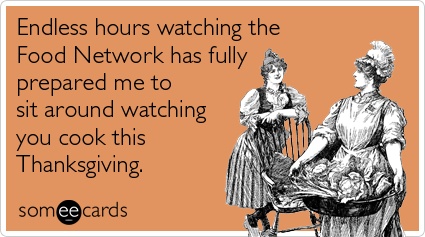
someecards.com - Endless hours watching the Food Network has fully prepared me to sit around watching you cook this Thanksgiving.


Confronted with the prospect of a lighter schedule for the first two weeks of this month, my body resolutely decided to go on strike.  Its strike was perfectly-timed: an autumn cold started on the day of our recital in Philadelphia, allowing me to perform the program reasonably unscathed.  The very next day, the cold settled comfortably into my upper respiratory system, setting up house, redecorating all the various respiratory passageways, painting them a lovely shade of infected pink.


Being incapacitated and forced to sit still at home for 10 days straight, restless and needing to direct my stir crazy energy somewhere useful, on top of sitting at my piano plinking out pitches in an effort to cram this music into my head (without actually singing it) for this upcoming concert, I ended up doing a bit of redecorating myself - all I can say is that my closets have never been cleaner or more organized.


My body, apparently satisfied with the vacation terms it had negotiated, slowly resumed cooperating with me just in time to go back to work to sing Bach with the Alabama Symphony last week.  Last week was a particular luxury, as I had the opportunity to work with all familiar faces and great friends.  Singing Bach with these friends was one of those special musical moments when there is nothing but music and play for me in both rehearsal and performance.  My duet partner for the Domine Deus (Kiera Duffy) and I barely had to utter words to each other in rehearsal - we just picked up on each other's musical instincts and responded spontaneously and effortlessly in sync with each other.  It was great fun to both sing with and listen to these good friends sing some of my favorite music ever composed.


While we were in Birmingham, the subject of nerves and stage fright came up, and we all commiserated about how we all have to grapple with it (you can read my colleague, Jenny Rivera's take on our conversations at her blog, here). It's so easy for us to beat ourselves about feeling it - it somehow feels as if we aren't courageous or brave, and because of that we are somehow inadequate to the task at hand. The thing is, I really don't believe that bravery is the absence of fear - I think it's the power to accept our fears and take a leap despite them.  


On the flight back to New York, thanks to the wonders of WiFi in the sky, I stumbled upon the video below by the actor, Edward Norton, discussing his experience with the terror associated with creativity and performance.


In a way, I feel that fear, while it feels like craziness, is actually sanity.  Without it, something doesn't feel right to me, and there is an essential energy that is missing.  The challenge is to accept it and not let it hold you back.


Anyway, I digress...mostly, I just was writing to check in and wish everyone in the US (and any Americans reading this abroad) a very Happy Thanksgiving.  Fortuitously, I am actually free for the holiday weekend this year (last year involved a flight to Kansas City and a surprisingly good room service burger that I ate while watching Monster-In-Law).  So, it will be nice to spend the day stuffing my face with turkey with family members for a change.  Just another moment that I can add to the long list of things I have to be grateful for this year.


I leave with you a gratitude-ful song that was attributed to Handel for a long time sung by one of my favorite singers:


Happy Thanksgiving!

Wednesday, November 09, 2011

Leadership and Community


Here's a fantastic New York Times profile on the conductor, Michael Morgan, from the other day (picture above is from the NYTimes article).


My two favorite quotes from the article:
“The thing I find most interesting about orchestras is using them to bring the town together...We want the fans of this music and that music, who may never see each other in real life, to come and watch a concert together.”
and 
“All of my ideas about bringing people together come from seeing myself as outsider...Being black in what’s considered a white music culture, being gay in a straight culture. Everything to me is about asking, ‘How do you use your outsider status to bring more people together?’ ”

Thinking back to last Friday's mostly-Britten recital in Philly, those comments coincidentally touch on what are central themes to much of Britten's work, and much of the music that Myra and I performed on Friday night.  It's pretty clear that Britten, himself, felt like an outsider throughout much of his life.  In the liner notes to our Winter Words album (which come with the album when you purchase it on iTunes, if you don't already have a copy), I wrote about how the first time I ever performed Winter Words, I felt very much an outsider in the community in which I was performing, and how singing Britten's music that night bound all of us in the hall together in a profound way.  Ever since then, I've been amazed at Britten's ability to create music that so movingly touches on these common human experiences.  When performing his music, I always feel that there is the potential to draw an audience's attention to the experiences that we share as humans, focusing on what binds us together rather than what it is that divides and differentiates us.  Last Friday's recital in Philly was no exception. 


In the end, perhaps I feel that way about most of the music I perform, but it was most certainly Britten's music that drew me to that realization about the connective possibilities of performance in the first place.


It's so great to see/read about a like-minded soul also making a mark out there in our present-day musical universe.

Thursday, November 03, 2011

Britten Humour

In honor of tomorrow's recital in Philly - a folksong setting that will not be on tomorrow's program...


I also came across this sweet picture of a young Benjamin Britten the other day - it looks like it could be his high school senior picture:


If I'm going to show Benjamin's Senior Picture (actually, I think he's 20 years old in that picture), I feel that I must be fair and show mine, too:


I must admit - I think Mr. Britten looks sharper and much more put together than I did...


Thursday, October 20, 2011

Purple Day


I'm wearing Purple today.  I hope you are, too.  If you're wondering why - read here.


If you're a young LGBT person being bullied or harassed - there's a wealth of resources for you to get help here and here.  Get help, keep hope, and stay alive...life really does get better.  


Here's one of my favorite "It Gets Better" videos:


Tuesday, October 11, 2011

Happy Coming Out Day

A very happy National Coming Out Day to one and all!  Here's something a little festive to celebrate to (complete with a over-the-top, fluffy gown):


I blogged about my own coming out story a few years back here.  I've been out for 16 years now, and I couldn't be happier.  


There is also an incredible site, I'm from Driftwood, that beautifully documents many people's coming out stories in both video and writing - check out a few of their favorite ones here.


To all those who are out and proud and our allies, I celebrate you, your bravery, and your inspiration.  To all those who are still working through the process of coming out and struggling to find that courage to show the world who you are: you are loved, it most definitely gets better, and there is an incredible community of wonderful people out here waiting to welcome you with open arms and loving hearts.  


Keeping Us On Our Toes


Myra warming up for our recital last Friday

After an entire year of slogging through airports alone, I slogged through the airport security for the umpteenth time on Thursday, only this time to be met by a very welcome sight after having all of my body and luggage scanned by strangers – Myra was sitting very calmly, reading her phone at the gate where our flight was to take off. She saw me and smiled as I sat down next to her, and we marveled at the fact that an entire year had passed since our last recital tour. About a half and hour later, our gate agent shuffled us on the plane, and we were off to our first recital of the 2011 – 2012 season, this one in the small town of Tryon, North Carolina.

Tryon is a beautiful little town nestled in the North Carolina Appalacian mountains, with a quaint little downtown filled with small, independently owned businesses (not a chain in sight!), and beautiful views of the tree-covered mountainsides that were just starting to turn from summer green to autumn red, orange and gold. We were excited to bring our Carnegie Hall Purcell/Britten program from last fall filled with so much beautiful music to this little town also filled with so much beauty.

Between our confident feelings about the program and the isolated, quiet nature of this adorable little town, we found ourselves almost feeling like were on a mini-vacation to the country. I turned to Myra at one point as we were warming up for the evening’s recital and said, “I almost feel too relaxed…this is really strange…”

After our warm-up in the hall, I went out to the lobby to get a program, when suddenly that very relaxed feeling evaporated into thin-air. I picked one up, only to discover that the presenters had not been able to print out our texts and translations in the program. I panicked - How will the audience know what these songs are about? How will they understand this music now?!

The omission turned out to be a bit of blessing in disguise – having toured the program last year and recorded it now, we both felt incredibly comfortable going into Tryon. Perhaps a bit too comfortable…Knowing that there were no translations for the audience to follow provided a bit of an edge to our concentration throughout the recital Friday. We were reminded with extra urgency that no musical nuance, no consonant, no vowel was to be taken for granted, and we felt an urgency to communicate each and every moment with the utmost clarity. It forced us to sharpen our message, and it forced us to refine our music-making. It forced us to stay on our toes.

I'm always grateful for the little reminders not to take anything for granted - It’s always a good thing to be kept on one’s toes, after all...


Wednesday, October 05, 2011

Quote

In honor of Helicon's concert last night at the Morgan Library (which was great fun), a quote from Proust, himself on the importance of the arts:

‎"Only through art can we get outside of ourselves and know another's view of the universe." 

Many thanks to my Helicon colleagues last night for an incredible evening of music-making, and to my dear friend, Susie, for sending this little gem my way.